Field cricket barrier treatment stops the annual late-summer population surges that drive millions of black field crickets toward artificial exterior lighting and residential brick weep holes across West Texas. High…
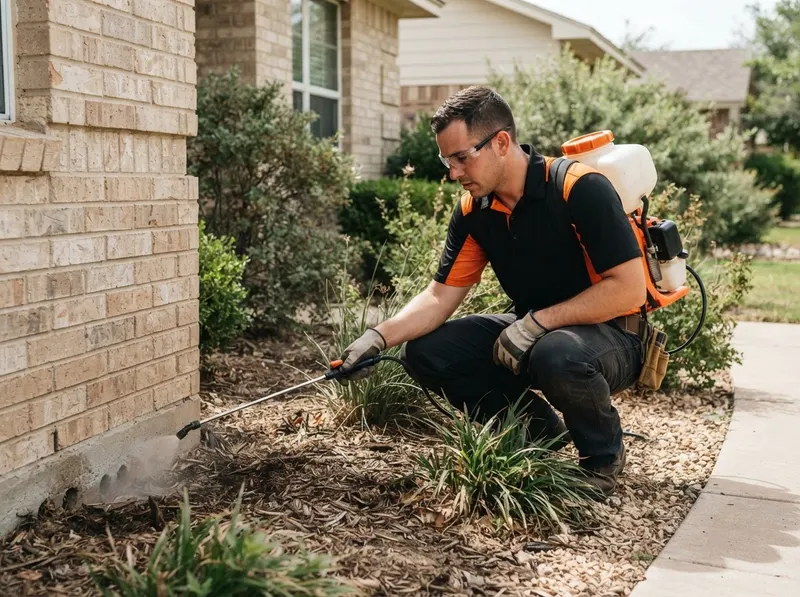
Field cricket barrier treatment stops the annual late-summer population surges that drive millions of black field crickets toward artificial exterior lighting and residential brick weep holes across West Texas. High August and September surface temperatures combined with sudden late-monsoon rainfall trigger mass molting events in surrounding agricultural soils. As ambient vegetation desiccates, crickets aggregate along shaded exterior concrete slabs, turf lines, and exterior foundations. In established neighborhoods like Melonie Park, Rush, and Kings Park, expansive mature tree canopies and landscape mulch beds create high-humidity microhabitats where crickets congregate by the hundreds before migrating under entry doors and garage seals into living rooms and bedrooms.
The barrier system establishes an uninterrupted exterior defense band measuring 3 feet vertically up the foundation wall and 6 feet outward along the soil, gravel, or turf margin. GreenShield Pest Control applies botanical-derived and synthetic pyrethroid microcapsules engineered specifically to resist rapid degradation caused by alkaline West Texas soils and high ultraviolet exposure. Unlike high-volume broadcast pesticide sprays that generate strong chemical odors and penetrate indoor air spaces, microencapsulated barrier particles bind to surface substrates and adhere to cricket tarsi and antennae upon contact. This mechanical exposure disrupts cricket central nervous activity within 24 to 48 hours without releasing volatile organic compounds into nursery rooms, pet recreation zones, or interior living areas.
A common misunderstanding involves confusing exterior barrier suppression with interior room fogging or DIY aerosol treatments. Store-bought bug bombs disperse volatile airborne mists that settle on household furniture, pet water dishes, and kitchen surfaces while doing nothing to eliminate the primary exterior population congregating against the brick veneer. True structural prevention requires treating the perimeter zones where field crickets physically stage their indoor entry. If an infestation is isolated to twenty or fewer stray crickets that slipped under an unsealed garage sweep during an overnight storm, mechanical exclusion, weather-stripping replacement, and vacuuming are often sufficient without broad chemical application. When exterior counts exceed several dozen insects per linear yard along patio perimeters in Southgate, Vintage Township, or Tech Terrace, a professional liquid-and-dust barrier perimeter represents the only measure that breaks the breeding and molting cycle at the property edge.
Every job gets a firm, written price after a free on-site visit.
Tell us about your field cricket barrier treatment job in Lubbock and we'll send a clear, written quote, usually the same day.
 GreenShield Pest Control